Showing posts with label lion of kerala. Show all posts
Tuesday, November 24, 2009 at 11:25 PM | 0 comments  

THE night of November 29, 1805 was surprisingly hot and humid in the jungles beyond Wayanad. A small army of rebels from Malabar had crossed over to the Mysore side and was holed up there, hiding from the British. None of them could sleep properly and there was a sense of unease.
The next morning, their leader, Kerala Varma, was up early. It was an important day for him, his mother's death anniversary. He bathed in the Mavila Thodu, and finished his prayers. He discussed strategy with his men for a while, and then they formed a protective circle around him as he sat on the bank and the ceremonies began. Suddenly, in the middle of the rituals, they found themselves surrounded by the English army under Sub-Collector Thomas Harvey Baber.
Bullets were fired and the men scattered. His men pleaded with Kerala Varma to escape, but he refused. In the ensuing confusion, a bullet caught him in the chest. With a prayer to Sriporkali, the goddess of Pazhassi, he collapsed on the bank. His men stood helpless, watching the end of their only hope of freedom.

Ingenious tactics

The story of Pazhassi Raja Kerala Varma isn't well known outside Kerala, but he was one of our country's first freedom fighters. He had to reckon with the armies of the Mysore rulers as well as the British. The British first used him against Tipu's army and then reneged on their treaty, coming in to usurp the land. He was forced to flee his palace in Kottayam with a band of trusted followers and spent the rest of his days in the treacherous Wayanad jungles, refusing to give up, and inflicting grave and humiliating injuries on the British. His survival depended on the loyalty and resilience of his subjects under British pressure and the ingenuous strategies he employed to evade and attack the enemy. Using guerrilla tactics and informers, he kept the British on tenterhooks for longer than any other regional ruler. When the British brought out their trump card, Colonel Arthur Wellesley, the strategy worked and ended in the death, if not capture, of the royal rebel.Pazhassi Raja Kerala Varma was exposed to warfare from his early teens. Many of his family members and several well-placed Nair families fled south because of local skirmishes and confrontations with Hyder Ali. But Kerala Varma stayed on in Pazhassi, determined to face the invaders, protect his people and remain close to the family deity, Sriporkali. Pazhassi's first revolt against the British began in 1793. The people were unhappy over the tax collections and the neglect of their welfare. The British selected a pliable administrator for Kottayam, ignoring Kerala Varma's claim, and gave him complete authority. The move was so blatant that even some British reports questioned its wisdom.

Uncanny knowledge

The British soon realised that they were up against a formidable enemy in Kerala Varma. Even when his palace was ransacked and he had to seek refuge in the mountains, he continued to frustrate their efforts with his guerrilla tactics. With the help of tribals and an uncanny knowledge of the treacherous jungles, he and his men indulged in cat-and-mouse games that depleted the strength of the British forces, and soon their single-point agenda was to claim the Raja's head. They accomplished this by befriending a dependant of Kerala Varma, a man who had come to him as a boy on the brink of starvation and grown up under his care. This man, Pazhayaveettil Chandu, knew the Raja and his hiding place intimately, and had no qualms about sharing his knowledge with the British. Kerala Varma was devastated by this betrayal. Even as they moved away to the Mysore side of the forest, they all sensed that the end was imminent.
There are no contemporary portraits of Kerala Varma that show his likeness, but word-pictures remain. Walter Ivor, a member of the former British Court of Directors, happened to be present during a discussion before the first peace treaty with Kerala Varma was signed. He describes a small man with a smile. His followers seemed to love and respect him greatly. Later, the Governor, Jonathan Duncan, who met the Raja in the Tellicherry Fort, had this to say about him: "Pazhassi Raja had long hair and a short thick beard, and was a small man. Sometimes he was in the habit of wearing a red cap. His face radiated a great glow."
His nemesis, Baber, was an energetic young man, reputed to be purposeful and correct. He made sure that people would see Pazhassi Raja's death as the death of a great king and not simply that of an enemy. He placed the body in his own palanquin, and the last rites were performed in a manner befitting a royal departure. Baber described the Raja as an "extraordinary and singular character".

Legend and history

British ranged from the idolatry to the acrimonious, and it was difficult to isolate the historical facts. The British had razed the original palace to the ground and built a road over it. Now there was this flat square piece of land beside the road and an ancient pond which, presumably, had been witness to many of the bloody goings-on.
Kerala Varma Pazhassi Raja [1750-1805], popularly known as the Lion of Kerala was a prince from the royal dynasty of Kottayam. He had three senior Rajas above him for his claim to the throne. However, when the Muslim Mysore army occupied Malabar for a second time [1773-1790] all the seniors of Kottayam Royal family fled to Travancore. It was Pazhassi Raja who led a well organized guerrilla struggle against Mysorean invader who were far stronger than Kottayam army. So he emerged in course of time as most powerful man in Kottayam as people stood firmly behind this beloved prince of theirs who had not abandoned them in hour of misfortune. . His troops were drawn from ranks of warrior Nayars as well as tribal Kurichias & Mullukurumbas. Pazhassi Raja an artist's view on a latterite wall
Kerala Varma Pazhassi Raja was born into Padinjare Kovilakam of Purannatt Swarupam, the royal dynasty of princely state of Kottayam. This Padinjare Kovilakam or Western Branch of this royal dynasty was located at Pazhassi. So came the nick name Pazhassi Raja. Kingdom of Kottayam covered what is today Talassery taluk [1000 sq.km] of Kannur District and Raja of Kottayam was also in possession of Wynad District [2000 sq.km]. Head-quarters of this kingdom was located in Kottayam, a small town not far from Tellicherry.
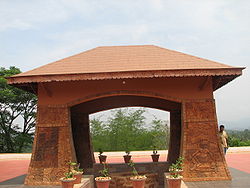
Pazhassi Kudeeram-a memorial for Pazhassi Raja at his burial spot in Mananthavadi, Wayanad,Kerala

Pazhassi Raja resisted British imperialism from 1793 onwards till his death in 1805. He fought two wars to resist English intervention in domestic affairs of his kingdom. From 1793-1797 he fought over the question of management of Kottayam and from 1800-1805 over the issue of who is master of Wynad.
First Revolt [1793-1797]
Pazhassi Raja was not on good terms with his uncle Vira Varma, Raja of Kurumbranad. In 1793, this foxy uncle Raja convinced British Commissioners to let him collect tax in Kottayam. He calculated that a good collection might please British and that will let him seize all of Kottayam. Needless to say that Pazhassi Raja was angry at this British move. He felt betrayed. After all he was the only Raja in Northern Malabar to have helped British consistently in war with Mysore. Vira Varma Raja was a real crook-on one hand he undertook to collect tax in Kottayam directly and on other hand he instigated Pazhassi Raja to oppose English. Moreover, British assessment was harsh and beyond peasant capacity to pay. They resisted forcible collection by agents of British and Pazhassi Raja took up their cause. As seen before, Raja was deadly opposed to extortion of peasantry. In 1793, Pazhassi Raja made sure that no tax was collected in Kottayam by English-as a mark of his protest. He also threatened that if British officials did not give up their enumeration of pepper vines, he will have vines destroyed. Local British authorities, however, debated with Raja and soon both discovered Vira Varma’s dirty games. So British put forward a solution acceptable to Raja by which 20 percent of gross revenue would go to Raja and another 20 percent would go for temples’ expense. No tax would be imposed on temple property in immediate future. In 1793, Tipu’s Vakils protested with British that Pychy Raja who was latter’s tributary had overrun most of Wayanad, still under Mysore. Soon Raja is supreme in Wayanad Plateau. But Governor General unwisely revoked the agreement in 1794 and gave Kottayam on a five year lease to Kurumbranad Raja. Raja was truly angry at this decision and decided retaliate by ruling his country as per customary law. That year before lease was concluded Raja provided asylum to a Nayar noble Narangoli Nambiar of Iruvazinad who had been declared an outlaw by British for murder of three men who killed his kinsman. Raja’s kind treatment to Nambiar irritated English. British also became angry that Raja impaled two robbers as per customary law. British planned to arrest Raja for ‘murder’ but gave up the idea as Raja had a bodyguard of 500 well armed Wayanad Nayars. In 1795, even after a year Vira Varma Raja got Kottayam on lease, he was not able to collect tax in Kottayam-thanks to his nephew Raja’s determination. So British troops arrived in Kottayam to help Vira Varma’s tax collectors, but Pychy Raja’s men resisted them with success In 1796, orders were issued from Bombay to collect tax arrears for 2 years in Kottayam. For British no more pretexts were needed to arrest Raja. 300 men under Lieutenant James Gordon marched from Talassery and seized Raja’s fortified house at Pazhassi-but Raja fled four days earlier to Manattana [near Kottiyur]. Gordon plundered the palace where traditional treasure of Raja was kept. Raja was angry at this loot and sent a letter to Supervisor at Talassery. Raja was also angry that one of his former general named Pazayamviden Chandu had become an agent of Kurumbranad Raja and what angered him even more than that was that this turn-coat had the audacity to boss him with Vira Varma’s and Britons’ blessings. Chandu was later killed by a follower of Kaitheri Ambu when latter was about to be killed by Pazayamviden. Raja shifted his HQ to Purali Range and then into Wayanad. Raja then blocked all British communications between Wayanad and Low Malabar through Kuttiyadi Pass. British retaliated by cutting all communications between Raja and Low Malabar. But as they did not have enough troops to chase him they waited for reinforcements. British commandant was Colonel Dow, whom Raja knew well during Siege of Talassery. So Raja thought that this old friend might help him mediate with British government. Raja offered to give up struggle provided he was pardoned and his treasure and house restored. Colonel and Raja being old soldiers hated needless bloodshed and so he forwarded Raja’s request to Commissioners, who though were bitterly opposed to Raja’s independent style, agreed to Colonel’s suggestion as there was a risk that Raja might ally with join with Tipu. So Northern Superintendent orders restoration of house back to Raja [but not treasure] and pardon to Raja was confirmed by Bombay and Supreme Governments. But orders of government was communicated to Raja via Vira Varma-which meant uncle Raja took care not to report his nephew of British agreement of his demands. Uncle Raja had vested interest in war between Company and his nephew Pazhassi Raja.
Vira Varma also removed Kaitheri Ambu, a favourite noble and general of Raja, form home administration of Kottayam. Ambu along with followers went to Kannoth, where he planned and executed a mass resistance with people’s support, which made sure that Vira Varma could make no tax collection in Kottayam. But Ambu acted clearly on guidance of Raja, who felt expulsion of Ambu was another of his uncle’s conspiracies to undermine him. Raja feared that British planned to seize him [not knowing that their truce terms were kept blocked from him by his uncle] and retreated into depths of Wayanad. British troop build up in Wayanad also accelerated his doubts. However Raja was still eager to avoid a war and came to meet Northern Superintendent with a bodyguard of 1500 armed men. Vira Varma Raja was also ordered to be present. Pazhassi Raja’s main demand was that Kottayam must be under his rule-a demand his uncle was not ready to accede. British Commissioners’ attitude also was arrogant-they were already prejudiced towards Raja and so were blind towards Raja’s logical argument that Vira Varma had no business in Kottayam. As talks broke down, Commissioners’ issued a threat proclamation in Kottayam that if those Kottayam men in service of Raja does not desert him and come home, they would be declare enemies and their properties would be confiscated. But this proclamation had little effect in Kottayam where resistance to British-Kurumbranad rule became stronger. British, to their horror, found out that a large number of Vira Varma’s troops had deserted to join ranks of resisters and Vira Varma himself was not much interested to help British-after all his aim was to create a flare up between his nephew and British for sake of pure self-interest. Raja then visited to Mysorean commandant at Karkankotta in 1796 and in 1797 held an audience with old enemy Tipu in Mysore who posted 6000 men at Karkankotta to aid Raja in case of war and also to supply ammunition to rebels. He also began to collect troops and armament. War was imminent. 1200 troops and artillery under Major General was sent by Bombay Government to deal with Pazhassi. British also began to set up outposts in Kottayam and sent more troops to Wayanad.In early 1797, Nayar militia rose all over Kottayam and British outposts were trapped in a true state of siege. Partisan bands became active all over Kottayam and harassed reinforcements and supply convoys. Same was the case in Wayanad where British troops that moved out of safety of block-houses risked being way-laid by Kurichia bowmen. British suffered good loss in terms of men, ammunitions and stores in these ambuscades. Periya Pass Episode-
This event is the most important in the whole war. In 1797, Colonel Dow & force marches into Wayanad. His plan was to block Periya Pass and then crush a large rebel force in Kannoth once their retreat is blocked. Reinforcements under Lieutenant Mealy were to reach Dow at Periya, but on way they were severely harassed by a force of Nayars and Kurichias and suffered a casualty of 105 men. So instead of Periya they retreated to their original base. Dow’s troops suffered chronic shortage of supplies and so Dow applied for reinforcements and re-supplies to be sent under Major Anderson of Bowles’ regiment. But as Mappila guides of Anderson deserted at last moment. That caused a delay in journey of Anderson-a delay that had fatal consequence for British.Dow then received news that Tipu had sent sepoys to aid Raja as Tipu considered British entry into Wayanad a violation of Seringapatam Pact. Dow decided that he will go to Talassery to consult authorities there and to plan a greater operation to deal with troops of Raja and Tipu simultaneously in Wayanad. He left with a small band of men but was ambushed on way by Raja’s men aided by Mysorean sepoys but Dow escaped unhurt. Day after he left, British force of 1100 under Major Cameroon in Periya decided to descend into Kottayam via Periya Pass as their supplies have exhausted. But what they did not know was that Raja who learnt of true state of British army laid a trap for them-he ordered troops lay concealed in camouflaged stockades built on both sides of pass. Once the whole British force entered the narrow pass, hidden troops were to pounce on their enemy who must be caught unawares. Plan worked well and what followed was great slaughter of British. Had it not been for arrival of Major Anderson’s force the following day, hardly any would have survived due to lack of medical care. Most of enemy were killed and all their guns, ammunition, baggage and cattle were plundered along with Union colours. Senior British officers like Major Cameroon, Lieutenant Nugent, Lieutenant Madge and Lieutenant Rudderman were killed in action. Around this time, Commissioners took a decision on advice of Swaminatha Pattar, a Tamil Brahmin who was minister of Zamorin that sowed the eventual downfall of Pazhassi Raja. They decided to raise an irregular force of local traitors to harass Pazhassi Raja. This force was a fore-runner of the infamous Kolkar, a Malabar version of Turkish Bashi-Bazouks, who became infamous for their sycophancy to British and cruelty to resisters and people. A brief introduction to Shamnath-He is an arch rogue who helped to consolidate British rule in Calicut. He was so hated by right minded people of Calicut that near kin of Zamorin made a nearly successful attempt to have this rascal killed. [Logan] But for time being, Raja was in a strong position. On account of British disasters, Bombay Government sent a Committee of Government composed of men of highest ranks-Commander-In-Chief Lieutenant General Stuart and Governor Jonathan Duncan. They decided to make peace as they were anxious that guerrilla warfare in a mountainous and forested terrain could last long and that Raja might join forces with Tipu or French. They also decided that Kurumbranad Raja Vira Varma should be ousted form administration of Kottayam. Rajas of Chirakkal and Parappanad acted as mediators in negotiation between Raja and British and a peace pact was signed between Pazhassi and British in 1797. Treaty of 1797 agreed on following points-
1. Pazhassi Raja was to be ‘pardoned’.
2. He will be returned his treasure.
3. He will be provided an annual allowance of 8000 rupees.
4. He will be given back his confiscated house at Pazhassi.
5. Ravi Varma, elder brother of Pazhassi Raja will be head of Kottayam. A pardon and restoration of property was also extended to Narangoli Nambiar of Iruvazinad also.Thus Raja’s efforts of four years ended in a political victory. Peace dawned after four years of antagonism and war.
After fall of Tipu, Wayanad fell to British. They sent a Mysore Commission to seize Wayanad and planned to annex it to either Canara or Coimbatore. But as Wayanad was a traditional possession of Kottayam Raja and that Pazhassi is in control of this region since 1793, Pazhassi correctly saw move was an encroachment on his country’s ancient provinces. Raja retaliated by collecting a large force of Nayars which was now supplemented by Mappilas and Pathans, latter being ex-soldiers of Tipu who became unemployed after Tipu’s death.
British Government at Madras appointed Colonel Arthur Wellesley as British army commandant of Mysore, Canara & Malabar- He planned a double pronged move from Malabar Coast and Mysore into Wayanad and began preparations for that end. Raja observed Colonel-latter had brought reinforcements and building roads in Wayanad and outposts across rebel country. In response, Raja also recruited numerous men which so alarmed Wellesley that latter even wanted to kidnap kith and kin of rebels so as to check Raja’s recruitment.
Raja learnt that Wellesley had left to Deccan on a military mission-Raja who understood that Colonel’s absence is a great chance swiftly made his move. He marched across Kuttiyadi Pass and below he made a junction with Unni Mutha Muppan, a Walluvanad Mappila leader & his men and soon several great nobles of Iruvazinad like Kampuratt Nambiar, Peruvayal Nambiar and Kannoth Nambiar also joined Raja with their men.
By monsoon of 1800, rebels who controlled all of country-side of Kottayam threatened to overwhelm British outposts in Kottayam. Wellesley sent a large force under Colonel Sartorius to recapture rebel held Kottayam. But the plan could not be carried out as there were not enough troops in Malabar. Wellesley advised Commissioners to stop all communications with Wayanad so as to starve Raja of supplies. But shortage of troops also meant this plan too remained on paper. By the time, Wellesley decided to smash Raja by a double drive from Malabar Coast and Mysore into Wayanad, Manjeri Athan Gurikkal an Ernad Mappila leader along with his followers agreed to support of Raja.
By 1801, a large British force of over 7000 men swarmed all over Kottayam and Wayanad and they blocked all passes that linked Wayanad with Malabar. Before so large numbers, rebels thought wise to go under-ground for time being. Raja also found that he could no longer contact his supporters in Southern Wayanad and Southern Malabar. Raja became a wanderer in forests but even then, to surprise of British, he ruled out compromise -it seems he understood that there was no alternative to full freedom.
Raja had six close aides and 25 musketeers in his wanderings. First he went north via Payyavur along montane forests of eastern Chirakkal to rally support. But British were on his trail but failed to catch him. Raja then visited his secret bases in Kottayam and then moved into Kadathanad and into jungles of Kurumbranad. British were angered that where ever he went, nobles supported him in secret and decided to punish them for their help to rebel Raja.
As a part of terrorization, Peruvayal Nambiar who was arrested was hanged. British also threatened brutal penalty and confiscation of property for all those rebels who failed to surrender in six weeks time. But a pardon was also issued for surrendered rebels. But none of these threats and temptations worked and Raja was still at large. But some of his chief supporters were arrested of whom Kannoth Nambiar was most famous. Kannoth Nambiar and his son were hanged too and their property was confiscated.
Following murder of Kannoth Nambiar, a deceptive calm descended on North Malabar-calm before storm. Collector Major MacLeod believed that war was over and went ahead with exploitation program. He immediately declared a total disarmament of Malabar and threatened those who kept arms with death penalty. He also doubled the rate of tax and ordered a reassessment of tax of whole Malabar in a mere forty days.
All these stupid ‘reforms’ paid back in 1803 when whole Malabar was on verge of revolt as people were pushed to wall. MacLeod tried to calm this with corrective measure-He cancelled all his ‘reforms’ and old system was reinstated. But it was too late for Wayanad where Raja’s men were prepared for a rebellion.
Capture of Panamaram Fort
First major event was capture of Panamaram Fort. Edachena Kungan planned the operation and was helped by 150 Kurichia bowmen under Talakkal Chandu. Fort had 70 men under Captain Dickenson and there was a large force of 360 men under Major Drummond only a few miles away in Pulinjali. So if Major came to help Captain in time Kurichia force would be overwhelmed by gun-fire and numbers. But Kungan and Chandu decided to take risk.
Whole garrison was slaughtered in the surprise attack led by the two generals and they lost only 5 dead and 10 wounded. Dickenson himself was killed. Rebels got 112 muskets, six boxes of ammunitions and 6000 rupees. They also destroyed the whole fort.
Wellesley was enraged at this rebel audacity and dispatched 500 men to retaliate. But by then rebel victory had roused all of Wayanad and Kottayam. Edachena Kungan, hero of Panamaram success, went to Pulpally shrine and issued a proclamation to people to join Raja’s war. 3000 men volunteered. They were posted at Valliyurkav at Mananthavadi, Motimjarra [?], and Edappally and 100 of them under brother of Kungan posted themselves at Periya Pass and 25 men were posted at Kottiyur Pass. Rebel outposts were set up en route from Dindimal to Valliyurkav. Rebel army was mostly composed of archers and sword men, but some had muskets.
Edachena Kungan led an attack on a British detachment headed from Mysore to Mananthavadi. Harassment began once this force entered Wayanad till it reached a stream between Manathavadi and Bhavully [?] river. There they were blocked by a rebel force entrenched on opposite side of stream. But to ill luck of rebels a reinforcement which had caught up with blocked British army outflanked the rebel entrenchment and took a large number of prisoners. All these prisoners were disarmed and marched to a road where they were murdered. [Logan]
Besides, British reinforcements arrived in Wayanad from all directions. But British could find rebels nowhere.
Rebels now concentrated in Kottayam. In 1802, they raided a supplies convoy near Kottiyur. British were frustrated by Kottayam people’s total lack of cooperation. To add to their trouble, in 1803, a rebel force took to field in Kurumbranad* & Payyormala* and people were sympathetic to rebels. Kungan marched towards Pazhassi to wipe out the British outpost there but had to retreat with large loss of men. But rebellion spread into Chirakkal where armed bands of partisans launched operations and often fought British openly. Raja’s army by end of 1803 was ranging as far as Kannur and Talassery.
[*Both in northern and eastern parts of modern Calicut District]
In March 1803, a rebel force marched as far as Calicut and captured Sub-Jail where they killed all guards and seized their firearms and ammunition. They also released prisoners, many of whom joined ranks of rebel army. This was too much for MacLeod and he resigned immediately after this event.
In 1803, Wellesley left for Europe, after three years of inconclusive war with Pazhassi Raja, later destined to become Duke of Wellington, vanquisher of Napoleon at Waterloo.
In 1804, a large British army arrived and 1200 Kolkar were also ready for action. Most importantly Thomas Harvey Baber, a cunning man was appointed as Sub-Collector. It was he who crushed Pazhassi Revolt forever. It is indeed ironic that what a military genius like Wellesley could not attain, a puny civil servant could!
In 1804, a huge rising lead by Kalyat Nambiar [a powerful Chirakkal noble but Raja’s sympathiser] and Raja’s men in largely forested eastern Chirakkal was crushed by British. If there was large and long revolt warfare in Chirakkal, it would have immensely profited Raja. Though there was a lot of supporters of Raja in Chirakkal, as revolt collapsed fast as rebels opted for open confrontation instead of time honoured guerrilla warfare. Another cause for failure of revolt was treacherous Kolkar also served their White pay-masters well.
So once more rebel force had retreat to Wayanad. They were hotly chased by British who had 2000 Sepoys and 1000 Kolkar. A reward of 3000 pagodas was offered for Raja along with 10000 Pagodas for Edachena Kungan and bounties were put on heads of 10 other associates of Raja.
But rebels, mostly Kurumbas, struck at Churikunji [?] in Wayanad. Though they had to withdraw, they had devastated their enemy. That year, a party of Kolkar nearly caught Raja but he escaped thanks to timely warning of a Kurumba guard.
But monsoon and brutal climate of Wayanad soon aided Raja. Of 1300 Kolkar only 170 were not sick by October. Raja and Edachena Kungan organized a large force of Kurichias and Kurumbas at Pulpally shrine and positioned them to as far as Kurichiyat. Also effort of Kungan to rally Nayar nobles of Wayanad to support Raja’s war-effort had also succeeded.
British for past couple of years did not have to suffer loss on a scale of Periya in 1797, but matters were not easy for British at all. Even in Kottayam which had become quiet might explode once more and a large rebel force with Raja as head was still at large. But one must remember that the whole revolt is a one man show as Wellesley himself remarked once-“We are not fighting 1000 men [Raja’s army]...but one man...Kerala Varma.” [ Raja’s end would mean end of revolt.
T.H Baber went to Mysore to direct operations himself and began a large search for informants and traitors. True, British themselves admit that they did not get lot of informants as locals were devoted to Raja, but some of those few informants proved devastating to revolt-one of them a Chetti, found out where Raja had camped and informed Baber who took to field with 100 Kolkar and 50 Sepoys.
On 1805, November 30, Raja and retainers were camped near close to Karnataka on shore of a stream named Mavila or Mavila Tod [not far from Pulpally]. Raja and party were caught by surprise and an intense but short fight followed. Large number of rebels fled away. Six rebels were killed. One of the earliest rebels to be killed was Pazhassi Raja.
Raja’ wife and her female servants along with 2 rebels were caught. Baber made arrangements for medical care of Raja’s wife who was dreadfully sick due to privations and made sure she got good treatment in captivity.
To credit of T.H Baber, he treated Raja’s body with due respect and arranged for cremation with full traditional honours. Baber justified his respectful treatment in following word-
“I was induced to this conduct from the consideration that, although a rebel, he was one of the natural chieftains of the country, and might be considered on that account rather as a fallen enemy.”
Baber also added-
“Thus terminated the career of a man who has been enabled persevere in hostilities against the Company for near nine years, during which many thousand valuable lives have been sacrificed and sums of all money beyond all calculation expended”
Opinion of T.H Baber in 1805 that-
“...but in all classes, I observed a decided interest for the Pyche [Pazhassi] Raja, towards whom the inhabitants entertained a regard and respect bordering on veneration, which not even his death can efface.”
Pazhassi Raja was only a junior prince of his dynasty and it was Fate that he rose to leadership. As foretold, people of all castes, tribes and classes of Kottayam & Wynad adored him as their beloved Raja. They came to love this man so much that he became a hero of folk songs in Northern Malabar
Following are some reasons why he can be viewed as a great man-
1. When Mysorean army invaded all kings and princes fled in terror leaving their people and land to its fate. But Pazhassi Raja preferred hard life in mountain fastness than comfortable sanctuary in Travancore.
2. He led mass resistance against Mysoreans and British, in which all sections of people, directly or indirectly took part.
3. His troops worshiped him as he was a fearless warrior and a first rate general who led from the front and lived during wartime as an ordinary soldier-he shared all soldierly hardships with them. He had great physical endurance that enabled him to fight in in the cruel mountain fastness of Puralimala and Wynad.
He knew well how to use his limited armed ability to resist far superior enemies. Remember, Raja's men were mostly armed with sabers and bows as gunpowder was short in supply and his enemies were superior in terms of numbers and fully armed with firearms. Yet, he defied Mysoreans for nearly 20 years and British for 10 years-Perhaps one of best examples of the fact that good leadership can compensate other handicaps.
British could conquer great powers like Nawabs, Marathas & Sikhs with far more ease once they opened war with them. But it took well over a decade to crush this turbulent prince who had no more than 3000-5000 men armed with primitive weapons.
What greater tribute is needed to Pazhassi Raja's military genius other than the fact that even Arthur Wellesley aka Duke of Wellington could not subdue him even after 3 years of severe struggle? Wellesley's experience in war with Pazhassi enabled him to use Raja's tactics in Spain to bleed Napoleon's army to death
4. Some historians like Woodcock have denounced Pazhassi Raja as a casteist and feudal obscurantist who have no feeling for low caste majority. But Pazhassi Raja cannot be expected to mouth slogans of French Revolution about which he had only a dim idea, if ever he knew of it.
But Raja's attitude towards low caste majority was generous and kindly indeed. For e.g-unlike his contemporary princes and lords of Malabar who on return from exile in 1792, launched a wave of inhuman tax extraction from Malabar people who had suffered endless privation in 20 year Mysorean terror, Pazhassi Raja borrowed a large sum from rich merchants and encouraged his farmer-folk with free seeds and saplings to resume agriculture.
Also as mentioned before Raja was opposed to exorbitant taxation of peasantry, who were majority of his subjects and mostly low caste,and it was this issue that led him to war in 1784 and 1793.
5. Raja took special care of his aides and troops. In fact, he was so brutal in revenge if any of his follower or his kin is harmed that not even most fearsome of bandits dare not to threaten Raja's followers' homes, where during war, only women and children were present.
6. Raja promoted capable men to key posts. All of them remained loyal to Raja to the bitter end. Only Pazayamviden betrayed his master. Had it not been for these able and loyal lieutenants, of whom Edachena Kungan, Talakkal Chandu, Kaitheri Ambu & Kannoth Nambiar are most important, Raja could not have held out against foreign aggressors for so long.